our methodology

Begin from a simple but critical observation

Despite the growing importance of cultural diversity in organisations and societies, it has historically been poorly defined and analytically neglected. The field of social science, particularly cultural studies, has long treated diversity as a broad, abstract concept rather than something measurable and actionable. This has created a “blurry space” where organisations recognise the importance of diversity but lack the tools to understand, benchmark, and improve it in a structured way.
Research Papers

Disaggregating Cultural Diversity

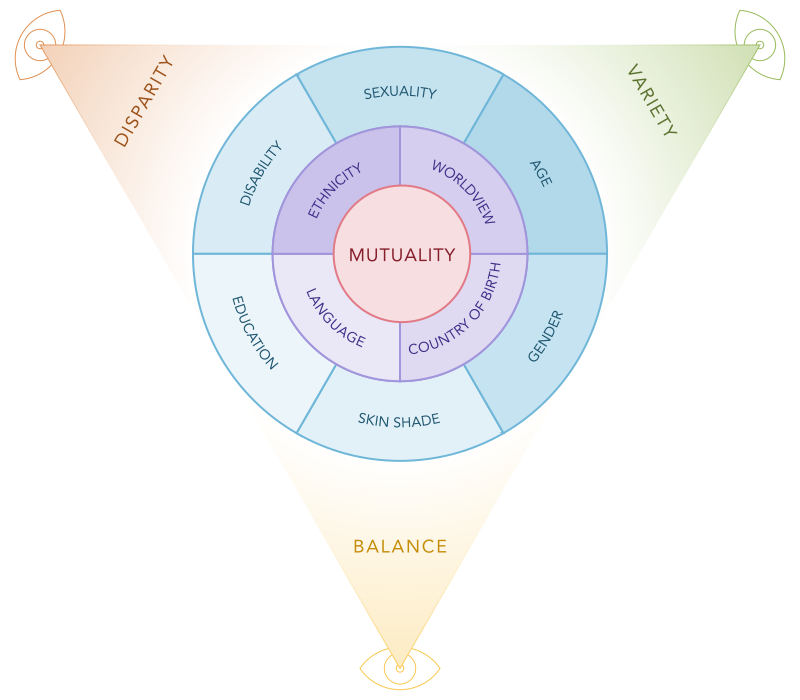
To address this gap, our approach starts by breaking down cultural diversity into measurable components. Rather than treating diversity as a single concept, we disaggregate it into three core elements. By combining these three elements, we move from a vague understanding of diversity to a structured and comparable framework. This allows organisations to not only measure diversity but also understand its composition.

Variety

Refers to the number of different cultural groups present within a population. This dimension captures breadth, or how many different identities are represented.
Example: A team with employees from 10 different countries has higher variety than a team with employees from only 2 countries.

Disparity

Reflects how different these groups are from one another. This dimension captures depth, or how distinct those identities are.
Example: A team made up of individuals from closely related cultural backgrounds may have lower disparity than a team composed of people from vastly different linguistic, religious, and cultural systems.

Balance

Refers to how evenly distributed these groups are within the population. This dimension captures distribution, or whether diversity is concentrated or shared.
Example: A scenario in which one cultural group makes up 90% of one department (for example ‘Sales’), but comprises only 10% of all the other departments is unbalanced.

Measuring Diversity

In our first paper, published in 2017, we introduced the idea of measuring diversity and identity priorities, using the theory of Entropy and L1 norm ( Rezza Moieni, Carlos Oscar Sorezano and Peter Mousaferiadis ) and later, we enhanced the method, in another research paper, titled “Analysis of cultural diversity concept in different countries using fractal analysis” which was published in 2022 (R Moieni , P Mousaferiadis)

Understanding the Gap

Research shows that many organisations struggle with this alignment, not because they lack intent, but because they lack a way to measure and track it effectively.
High mutuality
The organisation’s diversity closely mirrors its community. This typically leads to stronger trust, better communication, and more effective service delivery.
Low mutuality
There is a mismatch between the organisation and its community. This creates gaps in understanding, engagement, and performance.

The Role of Inclusive Datasets

  • The effectiveness of any diversity methodology depends on the quality of its underlying data. Simplified or biased categorisation leads to incomplete and misleading insights. Most organisations are making decisions on structurally flawed data models.
  • Datasets are not neutral. Traditional models rely on broad categories such as region or race, compressing complex identities and masking meaningful differences.
  • Inclusive datasets address this by capturing identity at a granular level, allowing precise representation across attributes such as ethnicity, language, and worldview. This produces a more accurate reflection of individuals and communities.

This approach improves both the accuracy and integrity of diversity analysis. It ensures that representation is not artificially flattened and that all identities are visible on equal footing, rather than prioritising dominant or more commonly recognised groups. As a result, organisations gain a clearer and more reliable understanding of their populations.

From a practical perspective, inclusive datasets enable more precise decision-making. Detailed data reveals patterns and gaps, supports targeted strategies, and improves alignment with the populations served. Limited datasets, by contrast, produce weaker and often misleading insights. This level of detail is scalable through technology, allowing large volumes of identity data to be processed efficiently without losing depth or accuracy.

Inclusive datasets are therefore a foundational requirement for any robust diversity methodology. They ensure that analysis is grounded in reality and that insights can be used with confidence to inform strategy and decision-making.
Image

Practical Implication for Atlas

Most organisations already collect diversity data. The problem is not data availability, it is the inability to structure, analyse, and act on it in a meaningful way.

Atlas operationalises this methodology into a decision system. It does not simply report diversity metrics, it transforms raw identity data into structured, comparable, and actionable intelligence.

With Atlas, organisations can:

Quantify diversity using structured measures of variety, disparity, and balance.
Capture identity across multiple dimensions without reducing individuals to fixed categories.
Benchmark workforce composition against external populations to assess mutuality.
Identify precise gaps between internal representation and the communities they serve.
Detect misalignment between workforce and community demographics.
Quantify underrepresentation with clear, measurable gaps.
Drive targeted actions to improve alignment, performance, and outcomes.
Intersect our culture and demographic data with sentiment, and any other enquiries you make.

Get

started

today

Realising the full potential of your organisation is just a few steps away.
Get a free demo