
25 February 2026
4 mins read


Published Paper
Title: Predicting Survey Response Rates Using XGBoost: A Case Study on Organizational Data
Published on: Open Journal of Social Sciences (2025)
Authors: Aida Hakemi, Rezza Moeini, Maslin Masrom
Get this paper
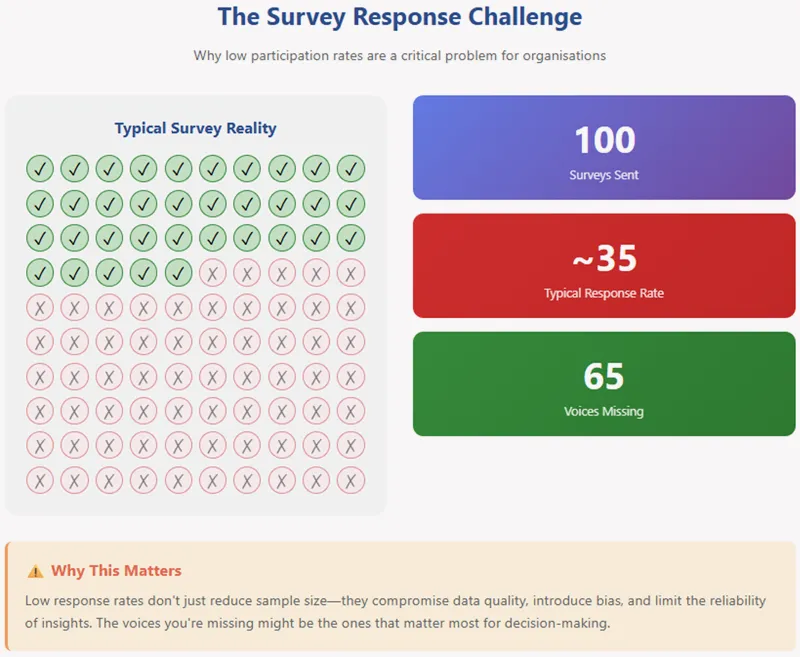
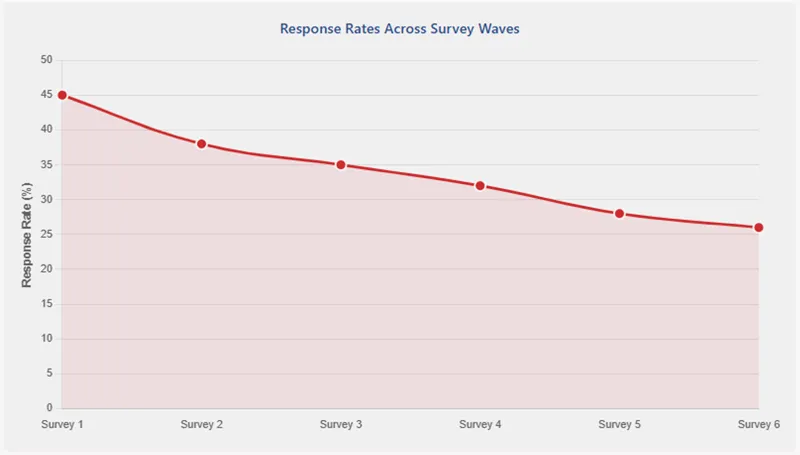
Anyone who has run an organisational survey knows the frustration: you put time into designing relevant, insightful questions, send the survey out, and only a tiny portion of people respond. Low response rates reduce participation and weaken the reliability of survey results.
This study asks a practical question many organisations struggle with:
Can we predict survey response rates in advance, and understand what actually drives them? According to our new research published in the Open Journal of Social Sciences, the answer is yes.
Why Survey Response Rates Are Hard to Predict
Survey participation is influenced by many overlapping factors. Timing, reminders, survey length, organisational context, and individual characteristics all play a role. Traditional statistical methods often examine these factors in isolation, making it difficult to capture how they interact in real-world settings.
As a result, organisations are often left guessing, sending surveys and hoping participation will be “good enough”.
This research takes a different approach.
Using Machine Learning to Model Survey Participation
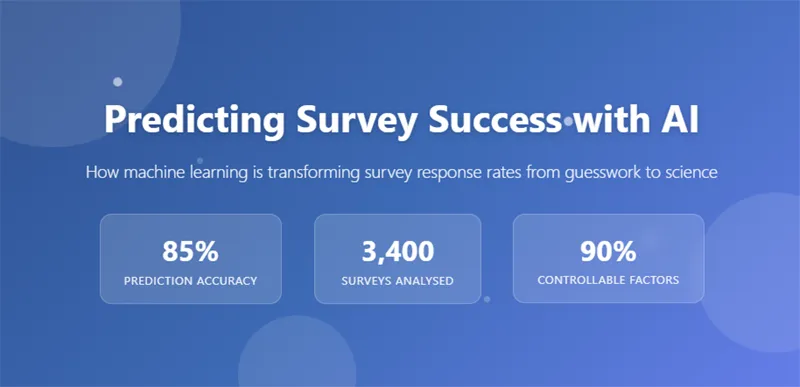
We analysed 3,400 real survey records collected through diversity and inclusion initiatives across Australian organisations. Rather than relying on traditional statistical methods, we used XGBoost, a machine learning algorithm capable of identifying complex patterns and interactions in data that simpler models often miss.
The research had two clear objectives:
- Predict survey response rates accurately
- Identify which factors most influence participation
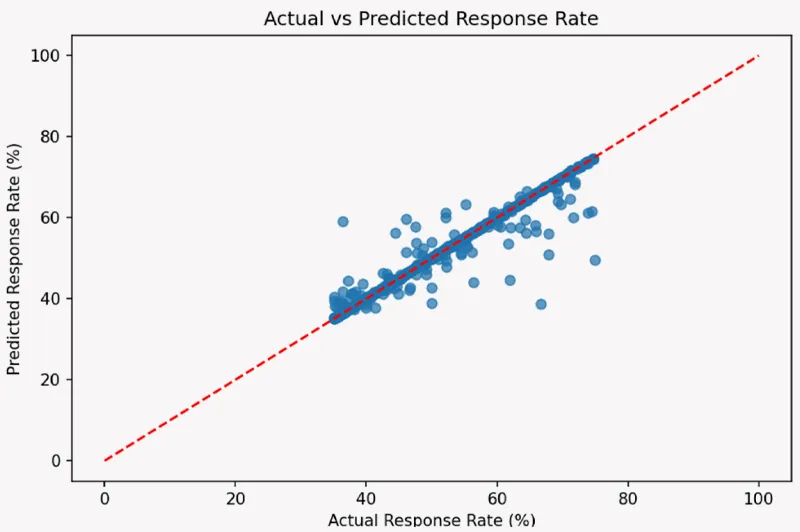
The model performed strongly, explaining 85% of the variation in response rates (R² = 0.85). In other words, its predictions closely matched actual outcomes—a level of accuracy that is difficult to achieve with conventional approaches.
What the Model Revealed
One of the most important findings is also one of the simplest: organisational decisions matter more than individual demographics.
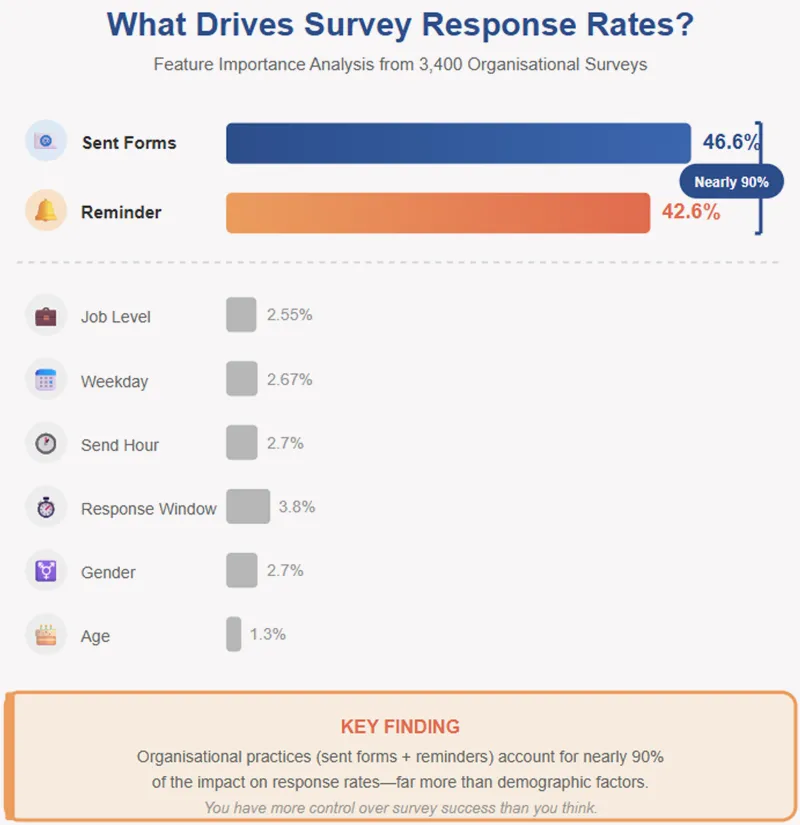
The analysis showed that two factors overwhelmingly drive survey participation:
- Number of survey invitations sent (46.6% of the model’s predictive power)
- Follow-up reminders (42.6% of the model’s predictive power)
Together, these account for nearly 90% of the model’s ability to predict response rates. Other factors had a smaller influence:
- Length of the response window
- Day of the week
- Job level
Demographic characteristics such as gender and age had relatively minor effects.
In practical terms, this means organisations have far more control over response rates than they often assume. How surveys are distributed and followed up is far more important than who receives them.
From Insight to Practical Use
The value of this research lies in its real-world application. The model can be used to:
- Estimate response rates before launching a survey
- Test different reminder strategies virtually
- Adjust timing and response windows based on evidence
- Improve survey planning over time using data-driven feedback
Rather than relying on intuition or trial and error, organisations can now make informed decisions before committing time and resources.
Why This Matters
Surveys play a central role in organisational decision-making, particularly in areas such as employee engagement, inclusion, wellbeing, and workplace culture. Low response rates are not just numbers—they often mean the voices that are missing are the ones that matter most.
At the same time, survey fatigue is increasing. People are asked to respond more frequently, with limited time and attention. This makes it even more important to design surveys that respect participants’ time and maximise meaningful participation.
This study demonstrates that machine learning can support that goal—not by replacing human judgement, but by strengthening it with evidence.
A Broader Shift in Survey Research
Beyond these immediate findings, the research points to a broader shift in how surveys can be designed and evaluated. By combining organisational data with machine learning, survey methodology can move from reactive analysis to proactive planning.
These insights extend far beyond HR or diversity surveys. Any field that relies on questionnaires, academic research, healthcare, market research, or public policy, can benefit from a clearer understanding of participation patterns.