
31 January 2026
6 mins read


White Paper
Title: Designed Forecasting Revenue Trajectories for Tech Companies 2024-2029: A Cultural and Market Diversity Analysis
Published on: Cultural Infusion Atlas (2025)
Authors: Neha Durgadmath, Rezza Moieni, Nicole Lee
Get this paper
Can we reliably forecast which technology companies will thrive, and which will merely survive over the next decade?
The pace of change in the technology sector seems to be relentless. New products, platforms, and business models emerge rapidly, while global events and shifting markets continually reshape the industry. In such an environment, forecasting the future performance of technology companies is both highly valuable and notoriously difficult.
We set out to examine whether advanced statistical modelling could help address this challenge. By analysing historical financial data from a diverse group of technology firms, we explored whether long-term reve nue trends could be predicted with meaningful accuracy, and what those predictions might reveal about the future of the sector.
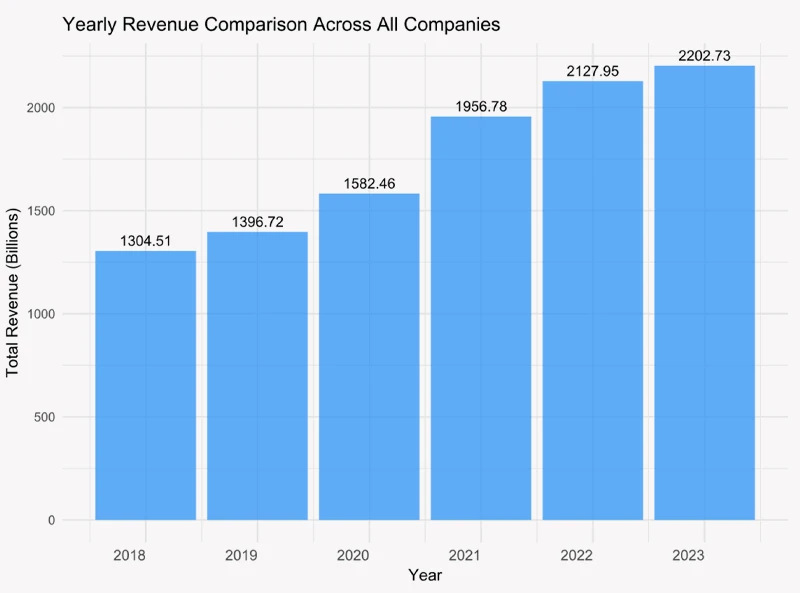
Figure 1 shows that despite volatility at the company level, total sector revenue followed a remarkably steady upward trend from 2018–2023.
Building a Model for a Complex Industry
Our study examined six years of revenue data from 32 technology companies, ranging from globally recognised organisations such as Apple, Amazon, and Microsoft to more specialised firms including Akamai and Fortinet. These companies differ not only in size, but also in market focus, geographic reach, and customer base by making them an ideal sample for testing forecasting approaches in a complex, heterogeneous industry.
Comparing Forecasting Approaches
To identify the most suitable approach, three established time-series forecasting models were evaluated:
• ARIMA (AutoRegressive Integrated Moving Average), a traditional statistical model that forecasts future values based on past trends and patterns in the data.
• ETS (Error, Trend, Seasonal), which decomposes time series into underlying trend and seasonal components and works well when patterns are relatively stable.
• TBATS (Trigonometric, Box-Cox transformation, ARMA errors, Trend, and Seasonal components), a more flexible model designed to capture complex, multi-layered seasonal behaviour often seen in global and fast-changing markets.
Each model was trained on historical data and then tested against actual revenue figures to assess predictive performance.
The comparison revealed a clear outcome. While ARIMA and ETS performed reasonably well in more stable contexts, they were less effective at capturing the complex, multi-seasonal patterns common across technology firms. The TBATS model, by contrast, consistently demonstrated stronger adaptability to rapid change and variation.
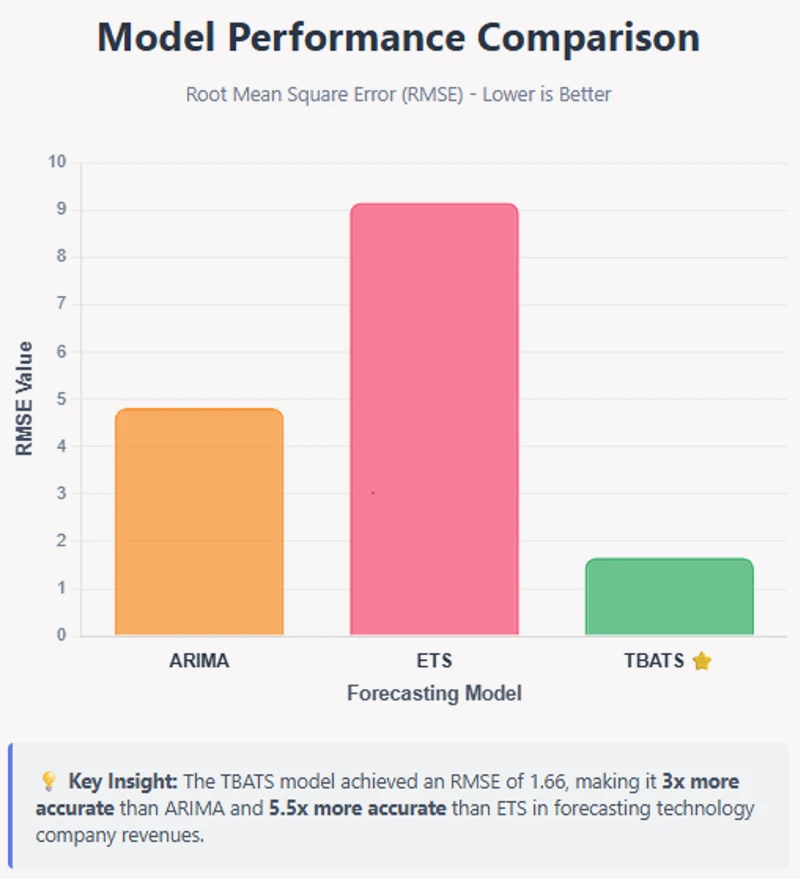
Figure 2 highlights the clear performance gap between models, with TBATS producing substantially lower error across the dataset, indicating a stronger ability to capture complex revenue patterns.
When compared with a simple baseline forecast that assumes future revenue will remain unchanged from the most recent observed year, the TBATS model reduced forecasting error by approximately 81%. For some organisations including Accenture and Cadence, the accuracy exceeded 96%, an unusually high result for a sector known for volatility.
How accuracy was measured
We evaluated accuracy using Root Mean Square Error (RMSE), which summarises how far forecasts deviate from actual outcomes on average.
Across the dataset, TBATS recorded an RMSE of 1.66, substantially outperforming ARIMA (4.82) and ETS (9.16), underscoring the importance of models that can accommodate layered seasonal and structural complexity in global technology markets.
What This Analysis Does Not Capture
This analysis focuses on revenue and does not account for profitability, valuation, or cost structures. The six-year historical window may also underrepresent longer economic cycles or major structural disruptions. As with all forecasts, results should be interpreted as informed estimates rather than precise predictions.
Looking Ahead: Revenue Projections to 2029
Using the TBATS model, revenue forecasts were generated through to 2029. Several distinct patterns emerged:
- Consistent growth trajectories were observed among companies such as Apple, Google, and Microsoft, reflecting stable expansion across global markets.
- Accelerated growth paths appeared in firms like NVIDIA and Salesforce, where innovation cycles and expanding demand suggest significant revenue increases over the coming years.
- Plateauing trends were evident among some established organisations, including IBM, Intel, and Seagate, indicating stability without substantial expansion.
These divergent trajectories have practical implications. Companies exhibiting consistent growth may benefit from long-term planning stability, while those on accelerated paths face scaling challenges related to talent, infrastructure, and risk management. Plateauing revenue trends, by contrast, may signal the need for strategic reinvention, portfolio diversification, or organisational transformation to sustain competitiveness.
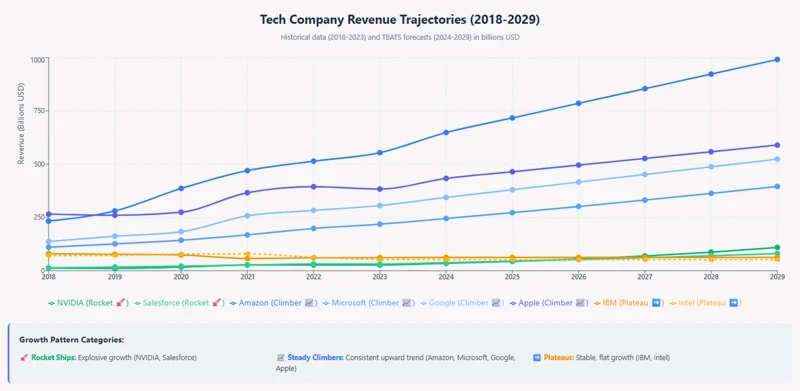
Figure 3: Revenue forecasts to 2029 for selected technology companies, highlighting divergent growth trajectories.
These projections, presented in detail in the full paper, illustrate how different strategic positions and market contexts influence long-term financial outcomes.
Why Forecasting Matters
Accurate revenue forecasting has implications far beyond financial planning, shaping decisions around investment, policy, workforce development, and long-term strategy.
Companies operating across multiple cultural and economic contexts often display more complex revenue dynamics, which require equally sophisticated analytical tools to understand.
A Diversity-Informed Perspective
This work forms part of a broader effort to examine how diversity influences outcomes in technology and beyond. The success of the TBATS model lies not only in its technical strengths, but also in its ability to reflect the multi-layered realities of globally diverse operations.
Companies operating across multiple regions and customer segments often exhibit overlapping seasonal patterns driven by differing fiscal calendars, regulatory environments, and consumer behaviours. These layered dynamics introduce structural complexity into revenue data, which simpler forecasting models struggle to represent. TBATS performs well in this context because it is designed to accommodate precisely this kind of multi-layered variation. Forecasting the future of technology is not about eliminating uncertainty, but about understanding its structure. This research shows that when forecasting tools are aligned with the complexity of global, diverse markets, they can offer meaningful insight into long-term trends. Used thoughtfully, such models can support better strategic decisions in an increasingly dynamic technology landscape.