
31 January 2026
4 mins read

Published Paper
Title: Quantifying Language Disparities: A Distance- Based Predictive Model Using Linguistic Tree Structures
Published on: Open Journal of Social Sciences (2025)
Authors: Akshata Chavan, Nicole Lee, Rezza Moieni, Mary Legrand
Get this paper
It is an interesting phenomenon that when we’re learning Spanish, for example, it is easier when we already know Italian – yet learning Mandarin feels like starting from scratch. There’s actually a measurable reason, and we’ve built a tool to quantify it!
The Invisible Problem in Multilingual Workplaces
In global organisations, people typically communicate in English, but beneath the surface, there’s an invisible force affecting productivity and job satisfaction: language disparity.
Language disparity isn’t just about speaking different languages, but also how fundamentally different those languages are. An English speaker working with a German speaker will find shared vocabulary and structure. Working, however, with a Vietnamese speaker? The linguistic distance is much greater – and that difference has real consequences.
Research shows that greater language barriers can lead to employees being excluded from networks, missing training opportunities, and feeling less satisfied with their jobs. Until now, though, we’ve had no reliable way to measure exactly how “distant” two languages actually are.
Turning Language Trees into Numbers
Linguists have long decided that languages sit in family trees – Spanish and Portuguese are siblings, English and German are cousins, and so on. But these classifications have been mostly qualitative. Our research team at Cultural Infusion’s Atlas developed a computational framework combining two approaches:
1. Following the Family Tree
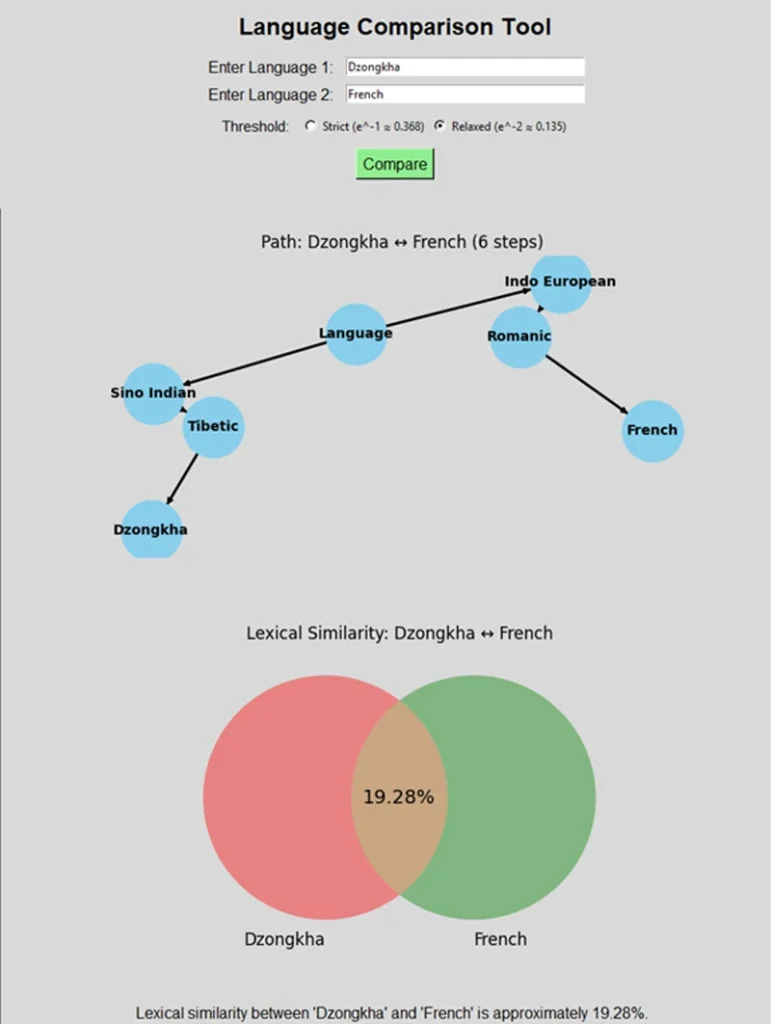
We trace languages back through their family branches to common ancestors using the Shortest Path Algorithm – the same math that helps your GPS find routes – counting each evolutionary step along the way.
2. Comparing Words
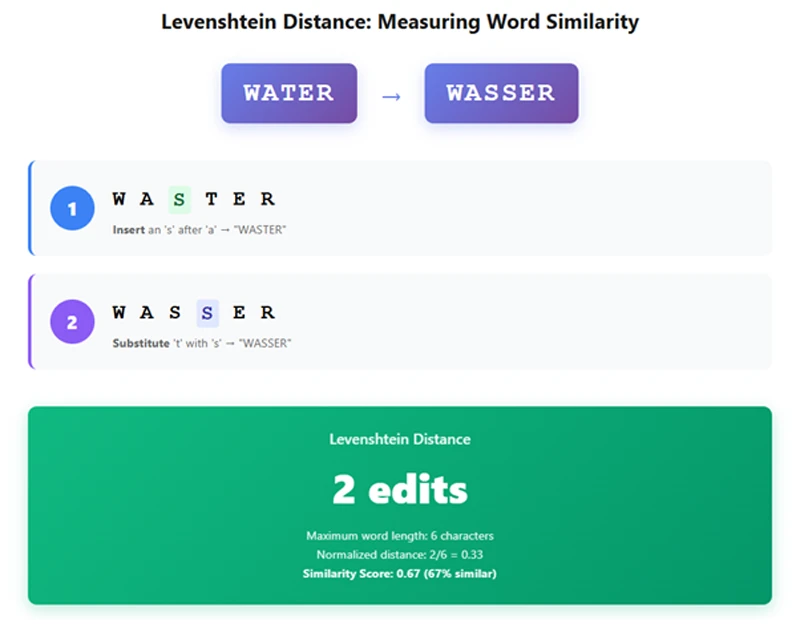
We used Claude AI to generate translations of four universal concepts (water, house, sun, hello) across different languages. Then we measured similarity with Levenshtein Distance – counting how many letter changes transform one word into another.
Examples:
- English “water” vs. Afrikaans “water” = identical
- English “water” vs. German “wasser” = pretty close
- English “water” vs. Japanese “mizu” = very different
3. The Decay Pattern
Linguistic similarity follows an exponential decay pattern – the same pattern biologists observe when species diverge. Languages that are close remain very similar, then similarity drops quickly before leveling off at very distant languages.
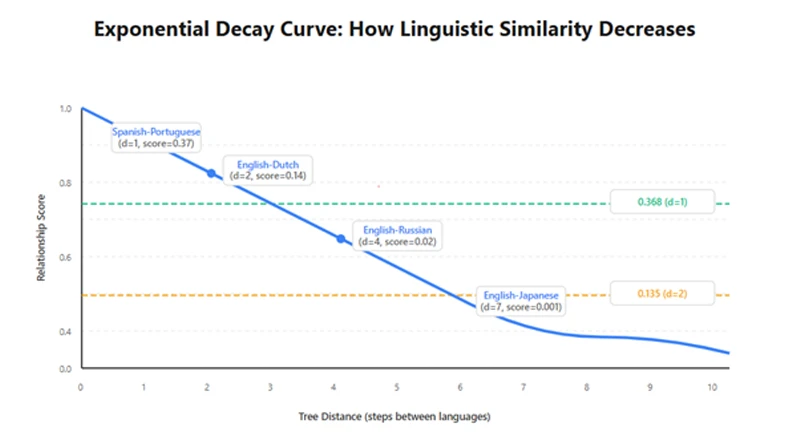
Our framework converts raw distance into a relationship score between 0 and 1, where higher numbers mean increasingly similar languages.
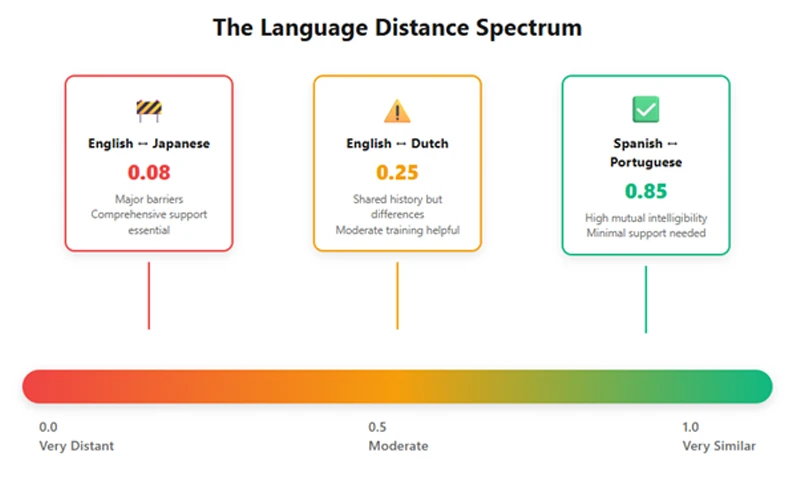
Score above 0.368: Spanish-Portuguese, Danish-Swedish. High mutual intelligibility. Minimal support needed.
Score 0.135-0.368: English-Dutch, Italian-French. Shared history but significant differences. Moderate training helpful.
Score below 0.135: English-Japanese, Arabic-Mandarin. Major barriers. Comprehensive support essential – translation, extended training, structured communication.
A Tool You Can Use
We built an interactive web tool where you type in languages and instantly see their relationship score, common ancestor, evolutionary path, and visual diagrams. Designed for HR managers and team leaders – no linguistics PhD required.
Why This Is Unique
Our framework is fast and scalable, using simple vocabulary sets (generated via Claude AI) and structured language trees with established algorithms. Users get a single, clear number relating to real-world communication difficulty.
Why This Matters
Language distance shapes who might speak up in meetings, who can access information, and who, ultimately, feels they belong. By measuring these invisible barriers, leaders can strategically pair employees, allocate translation resources, and design fairer communication policies.
What’s Next
We’re planning further improvements: verifying AI-generated translations with linguistic experts for rare languages, including sign languages, and building dynamic language trees that evolve as our understanding grows.
Effective communication isn’t just about speaking the same language. It’s about understanding how far apart we are, and building the right bridges to close that gap.