
3 June 2026
4 mins read


Published Paper
Title: Predicting Workplace Conflicts through Intersectional Analysis of Social Identities of Employees: A Multilevel Statistical Modelling Approach
Published on: Open Journal of Social Sciences (2026)
Authors: Archana Natarajan, Mary Legrand, Nicole Lee, Rezza Moieni
Get this paper
In our new research published in the Open Journal of Social Sciences, we asked a question that organisations rarely measure directly: Which employees are most at risk of workplace conflict, and does that risk compound when multiple aspects of identity intersect?
The Problem with Single-Axis Analysis
Workplace conflict, ranging from interpersonal friction to identity-based tension, remains a persistent challenge to organisational productivity and employee wellbeing. Research has long studied conflict through single identity lenses: gender alone, nationality alone, or disability alone. But this approach misses something important.
Intersectionality theory, shows that social identities do not operate independently. They interact in ways that produce unique experiences of risk and disadvantage that single-axis analyses cannot detect. An employee who is a non-American woman in a junior role identifying as LGBTQ+ does not face the sum of four separate risks. She faces a compounded, structurally distinct form of vulnerability.
Despite this being well understood in theory, robust quantitative methods for capturing intersectional conflict risk in workplace settings have been largely absent. This study addresses that gap.
How We Studied It
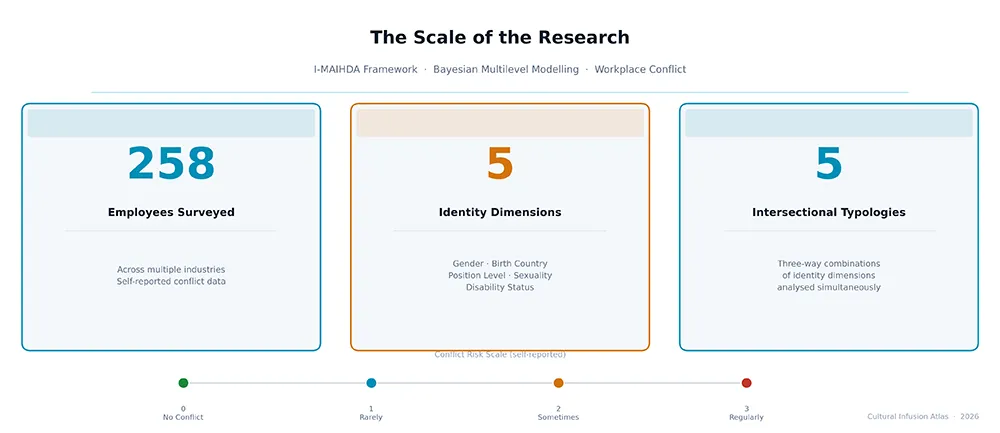
We applied the Intersectional Multilevel Analysis of Individual Heterogeneity and Discriminatory Accuracy (I-MAIHDA) framework to survey data collected from 258 employees across multiple industries. Respondents self-reported their experience of workplace conflict in the past 12 months on an ordinal scale from 0 (no conflict) to 3 (regular conflict). Demographic variables included gender, birth country, position level, sexuality, and disability status.
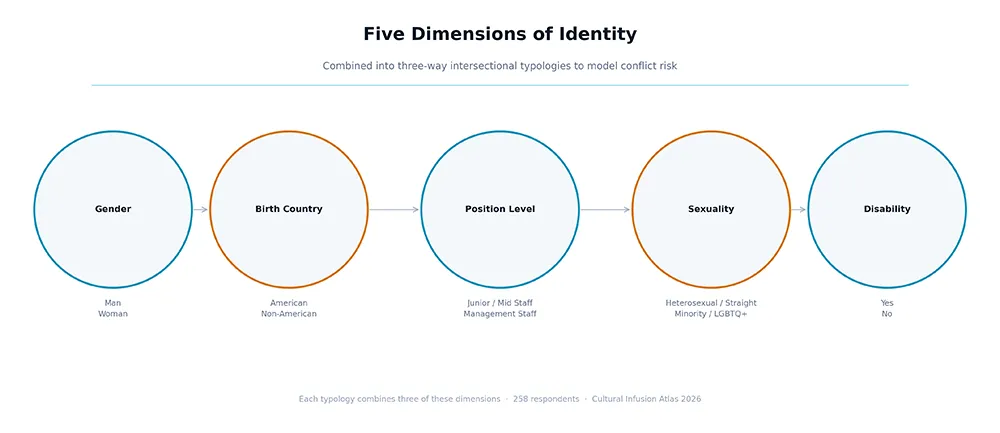
Five three-way intersectional typologies were constructed, such as Gender x Birth Country x Sexuality and Gender x Position Level x Disability. Bayesian ordinal multilevel models were used to estimate conflict risk across each group, and Posterior Predictive Checks validated that the models accurately reproduced both group means and within-stratum variability.
What the Results Showed
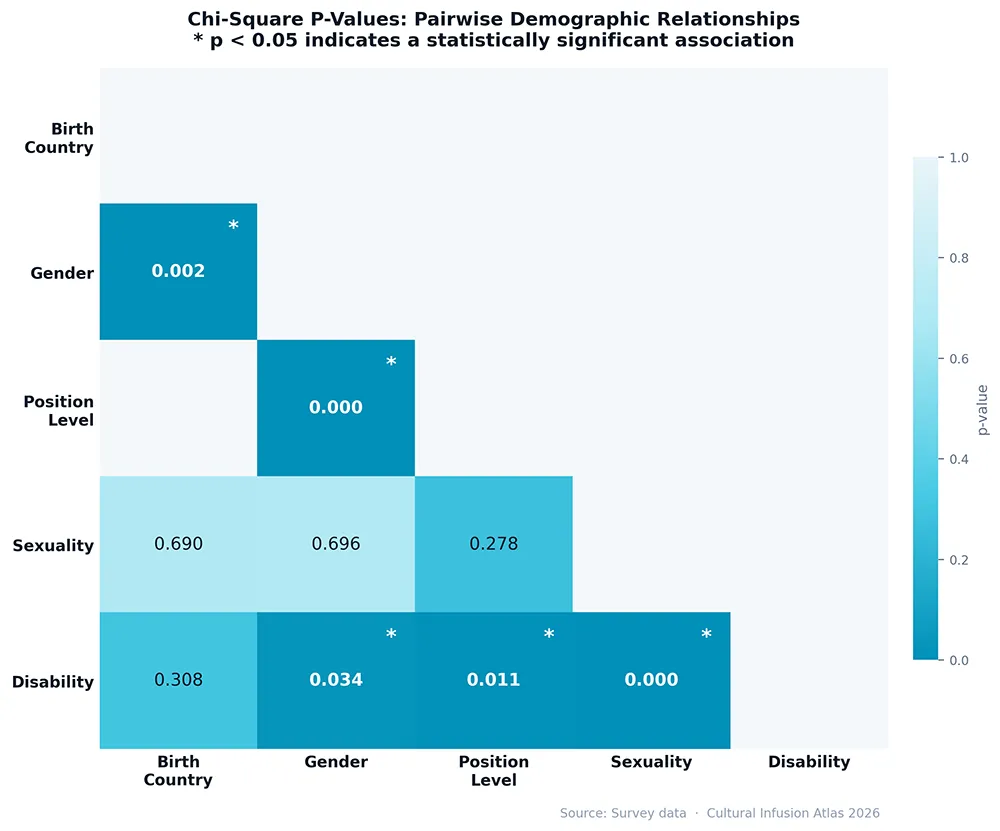
The results reveal substantial heterogeneity in conflict risk across intersectional groups, a level of heterogeneity that additive single-axis models consistently fails to capture.
Across all five typologies, the data showed that employees sitting at the intersection of multiple marginalised identities face conflict risks far greater than what any single identity dimension would predict. The combination of gender, nationality, and sexuality produced some of the strongest disparities, with certain groups reporting conflicts at rates several times higher than the most protected groups in the same dataset.
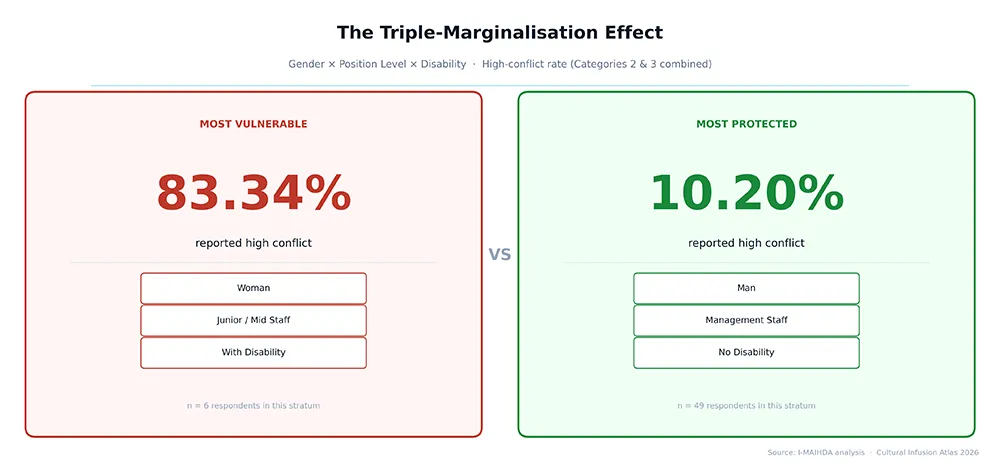
The starkest finding came from the Gender x Position Level x Disability typology. Women in Junior roles with a disability reported a combined high-conflict rate of 83.34%, the highest recorded rate across all five typologies. Men in management roles without a disability, by contrast, reported a high-conflict rate of just 10.20%. This gap illustrates the triple-marginalisation effect in concrete terms and makes clear why looking at any one of those identity dimensions in isolation would have hidden the problem entirely.
Why This Matters
Traditional diversity and inclusion strategies often focus on single categories such as women in leadership or employees with disabilities. This research shows that such approaches can overlook the groups facing the most acute and compounded risk.
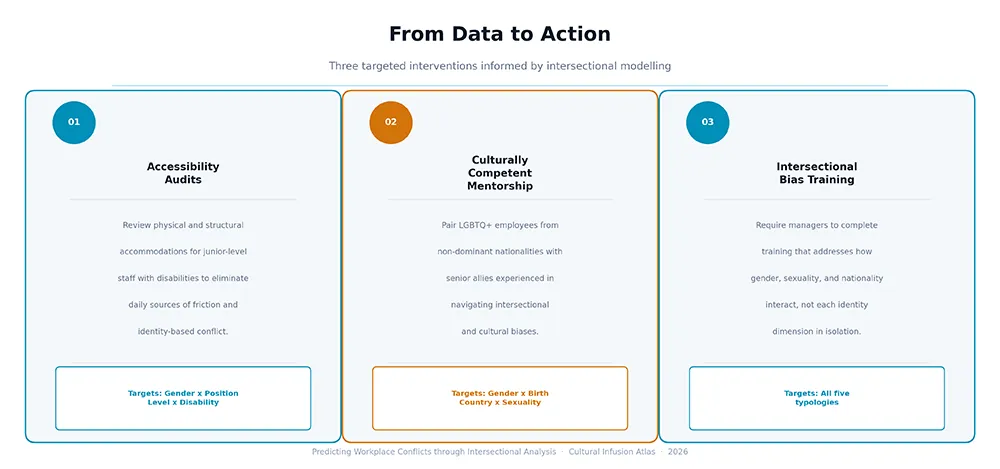
By applying predictive intersectional modelling, organisations can move beyond surface-level metrics to identify which employee groups are most vulnerable and design targeted interventions accordingly. These might include accessibility audits for junior-level staff with disabilities, culturally competent mentorship for LGBTQ+ employees from non-dominant nationalities, or managerial training that addresses intersecting forms of bias rather than each identity in isolation.
Looking Ahead
This study used a cross-sectional design with a relatively small sample, which limits causal inference and generalisability. Future research should expand the identity dimensions analysed to include race, age, and socioeconomic status, and use longitudinal designs to trace how intersectional conflict risk evolves over time and in response to organisational interventions.
The core finding is clear. Workplace conflict is not randomly distributed. It is structurally patterned by the intersections of identity, and organisations committed to equity cannot afford to examine those identities one at a time.