
14 May 2026
5 mins read


Published Paper
Title: Quantifying the Distance between Religions: A Survey Based, Data Driven Approach
Published on: Open Journal of Social Sciences (2026)
Authors: Pavithran Thilakanathan, Rezza Moeini, Mary Lagrand
Get this paper
In our new research published in the Open Journal of Social Sciences, we asked a question that sounds simple but has never been properly answered: Can we quantify how similar or different religions are based on the actual values and beliefs of their followers?
Why a Dedicated Framework Has Been Missing
Religion shapes moral values, social behaviour, attitudes toward authority, and views on life and death. Yet despite its central role in human identity, no dedicated methodology has existed to measure the cultural distance between religions directly.
Well-known frameworks such as Hofstede’s cultural dimensions, the GLOBE study, and Inglehart and Welzel’s cultural map have helped researchers compare countries and societies. But in all of these models, religion is treated as a single variable rather than something that can be analysed on its own terms. Without a clear framework, comparisons between religions remain subjective, different scholars can reach entirely different conclusions depending on what they choose to focus on.
This research addresses that gap directly.
Measuring Religion Through People, Not Texts
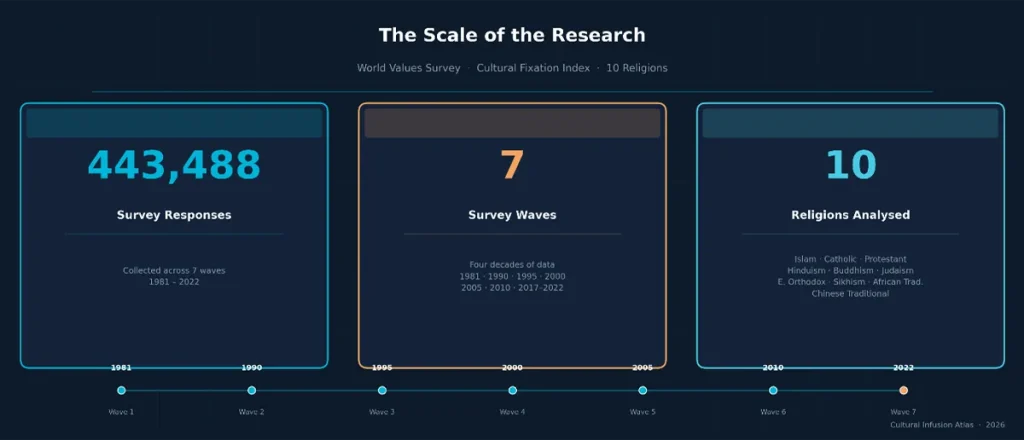
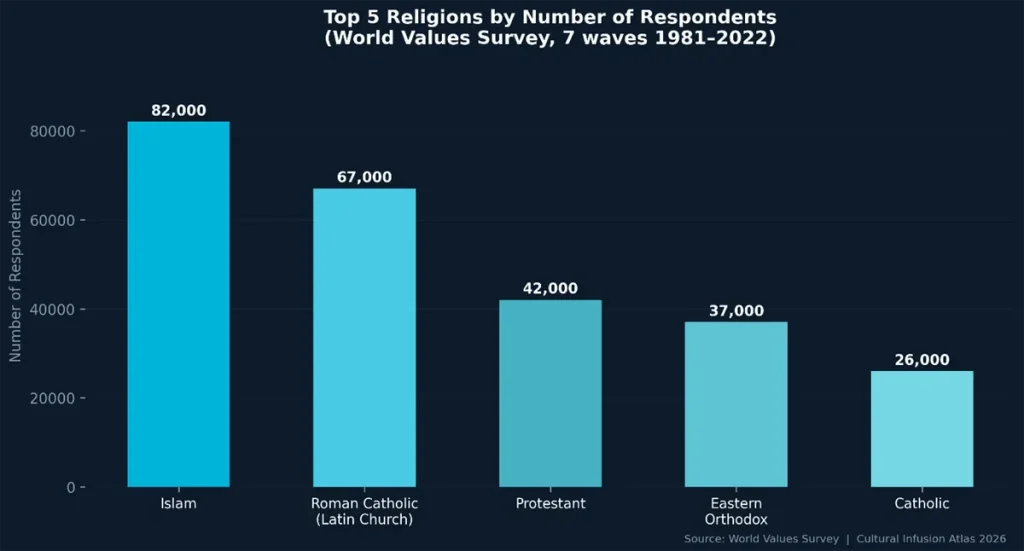
Most studies of religion focus on sacred texts, doctrines, or historical traditions. But religions are lived by people, not just written in books. Two people from the same religion may hold very different views on politics, gender roles, or morality, while people from different religions may share similar values around family, work, or society. Rather than focusing on theology alone, we looked at religion through the lens of real human responses. We used data from the World Values Survey; 443,488 responses collected across seven waves from 1981 to 2022, grouping respondents by religious affiliation and comparing their answers across dimensions including metaphysics, ethics, eschatology, soteriology, and religious practice.
Borrowing an Idea from Genetics
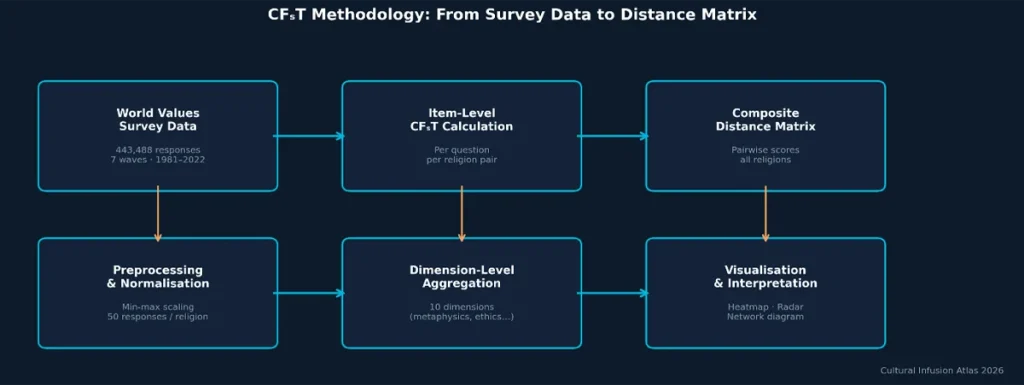
The core method is the Cultural Fixation Index (CFST), adapted from the fixation index used in population genetics to measure how much variation exists within a group compared to between groups. Applied to survey data, it calculates a distance score between religious groups based on the full distribution of responses — not just averages, so that internal diversity within each religion is preserved in the calculation.
For each pair of religions, pairwise CFST values were computed across all selected survey items. These were then aggregated into a composite distance matrix, producing a replicable and data-driven map of inter-religious variation.
What the Results Showed
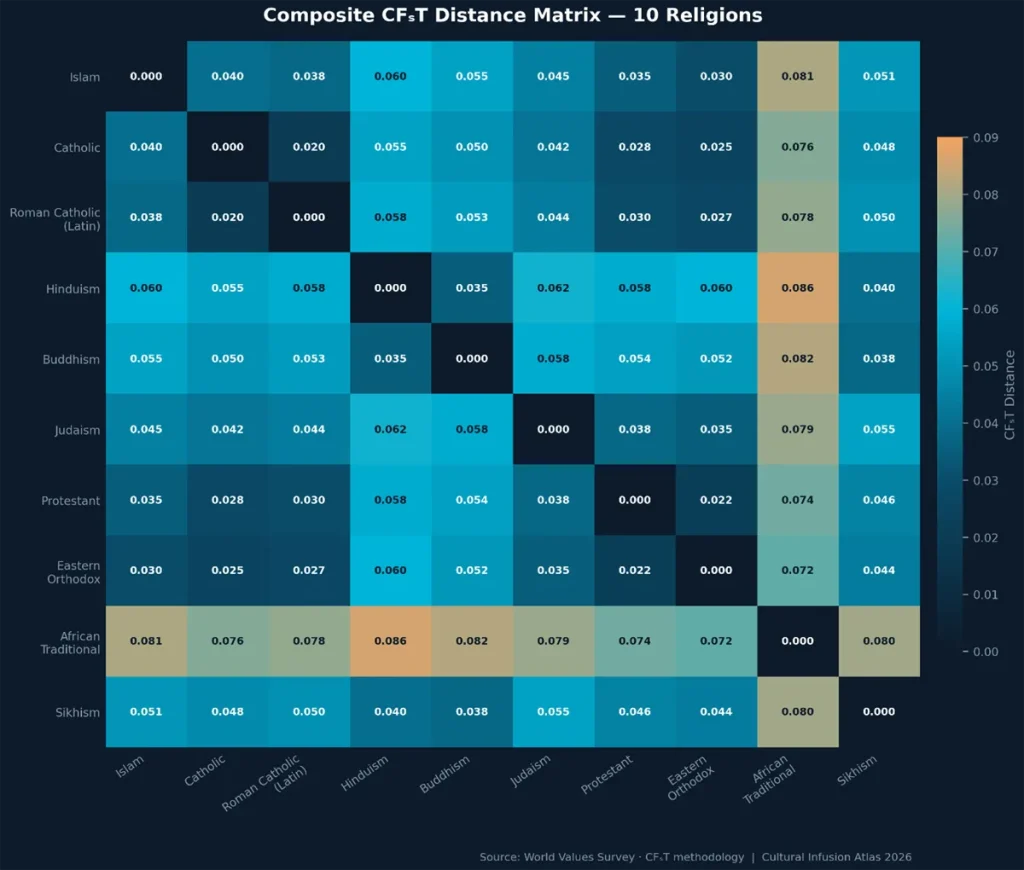
The results reveal clear clustering patterns. Abrahamic religions: Islam, Catholicism, Protestantism, and Judaism, show relatively low pairwise distances (CFₛT = 0.05–0.12), suggesting broadly aligned value orientations despite their historical differences. Non-Abrahamic religions such as Hinduism and Buddhism show higher distances from these groups (CFₛT = 0.18–0.27), reflecting stronger differences in moral and metaphysical outlook.
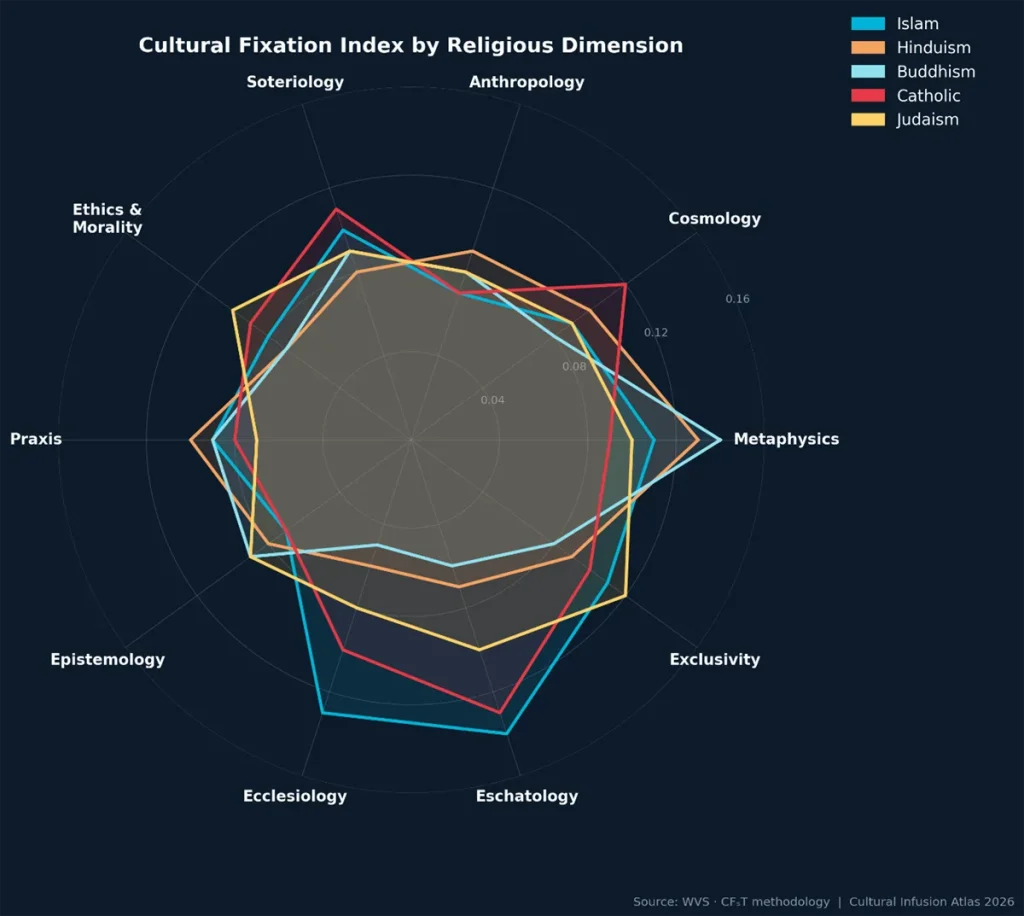
Importantly, the strongest markers of difference were not ritual or liturgy, but deeper value orientations. Among the ten dimensions analysed, metaphysics, eschatology, and exclusivity showed the highest CFST scores across most religions — meaning that how followers think about the nature of reality, the afterlife, and religious identity are the dimensions that most clearly distinguish one religion from another.
Looking at individual profiles, Islam extends strongly on eschatology and ecclesiology, reflecting its emphasis on structured theology and community organisation. Catholicism shows similar peaks in cosmology and eschatology. Buddhism extends further along metaphysics, reflecting its distinct ontological orientations. Religions may appear similar on the surface, but data reveals clear structural distinctions in how their followers understand life, meaning, and community.
Why this matters
This research is not about ranking religions or judging beliefs. It is about replacing assumption with evidence. When religious differences are discussed only in political or emotional terms, misunderstandings multiply. People assume distance where there may be similarity, and similarity where there may be real differences.
A data-driven framework has practical implications across many fields. In intercultural communication, migration and integration policy, education, and diversity and inclusion work, understanding how belief systems differ and by how much, enabling better-informed decisions. It also provides a foundation for conflict resolution and global workforce analytics, where religious identity is a significant but often poorly understood variable.
What comes next
This research is a starting point. Future work could apply this methodology to additional waves of survey data, extend it to worldviews and ideologies beyond formal religion, and integrate large language models to analyse religious texts alongside survey responses. A genealogical family tree of religions and denominations could also add a further layer of depth to the distance calculations.
The method is replicable, variance-sensitive, and scalable. Once something can be measured consistently, it can be understood more clearly — and acted on with greater confidence.