
14 February 2026
6 mins read

Published Paper
Title: Media Diversity Forecasting: A Longitudinal Study Using Hybrid Machine Learning Model for Predictive Insights into Community Representation (2004-2024)
Published on: Open Journal of Social Sciences (2025)
Authors: Siddharth Yadav, Nicole Lee, Rezza Moieni
Get this paper
Can we actually measure whether media is becoming more inclusive and predict where it’s headed next?
One of our recent research studies suggests that this is not only possible, but also necessary if we are to understand how media representation is evolving.
After decades of conversation about diversity in media, many communities still struggle to be seen or are seen unfairly, in ways they would not choose for themselves. While progress is often claimed, it’s rarely tracked with precision, and almost never projected into the future.
That gap is exactly what our research set out to address.
The Problem We Don’t Talk About Enough: Flying Blind on Representation
Media representation isn’t just about visibility, it shapes public opinion, policy priorities, and how communities experience belonging. Yet despite its influence, representation is still measured inconsistently, often anecdotally, qualitatively, and usually after the fact.
The result?
We debate progress without reliable baselines. We react to crises, and desperately poor representation, instead of preventing them and it. And entire communities remain underrepresented or misrepresented, without anyone noticing until the damage is done.
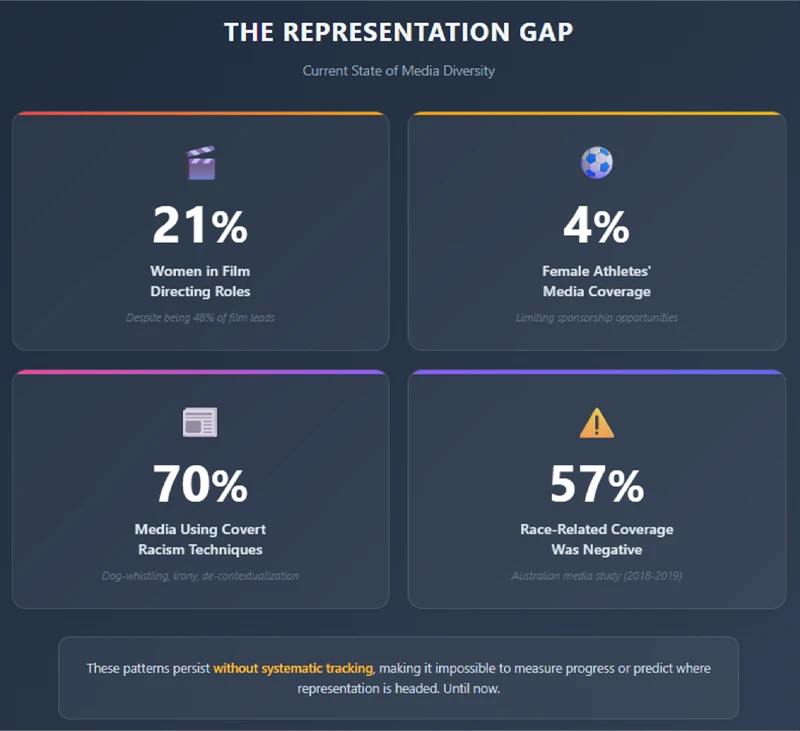
Consider just a few well-documented patterns:
- Muslim women continue to receive disproportionately negative coverage
- Indigenous voices remain marginal across major platforms
- Women are still rarely seen in film directing roles.
- Female athletes receive just 4% of sports media coverage
What’s been missing is a way to track these trends systematically and forecast what happens if nothing changes.
A New Way to See the Future of Media Representation
We have developed an AI-powered forecasting system designed to do exactly that. By analysing 20 years of media data (2004–2024), the system models how different communities are represented across news media, social platforms, and entertainment, then projects those trends forward to 2035.
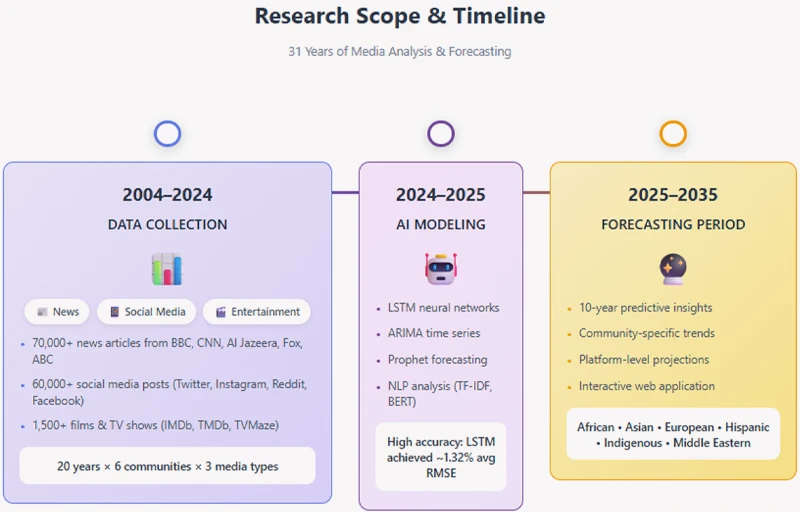
The study, published in the Open Journal of Social Sciences—focuses on six communities:
African, Asian, European, Hispanic, Indigenous, and Middle Eastern, spanning outlets from BBC and CNN to Instagram, Hollywood, and Bollywood.
This isn’t speculative futurism. It’s data-driven forecasting.
What the Models Showed
Using a hybrid modelling approach that combined LSTM neural networks, ARIMA, and Facebook’s Prophet algorithm, the study achieved forecasting accuracy that outperformed existing benchmarks.
- LSTM neural networks are designed to detect long-term patterns in sequential data, making them especially good at capturing the complex, non-linear ways representation can rise, stall, or decline over time.
- ARIMA (AutoRegressive Integrated Moving Average) is a statistical model that analyses past trends to make short-term forecasts, providing a reliable baseline for comparison.
- Prophet, a forecasting tool developed by Facebook, is designed to handle changing trends and seasonal patterns in real-world data, helping to account for shifts in representation over time.
By combining these approaches, the models complement each other: LSTM captures complex, long-term dynamics, ARIMA provides a solid trend-based baseline, and Prophet adjusts for seasonal or sudden shifts together producing more accurate and nuanced forecasts.
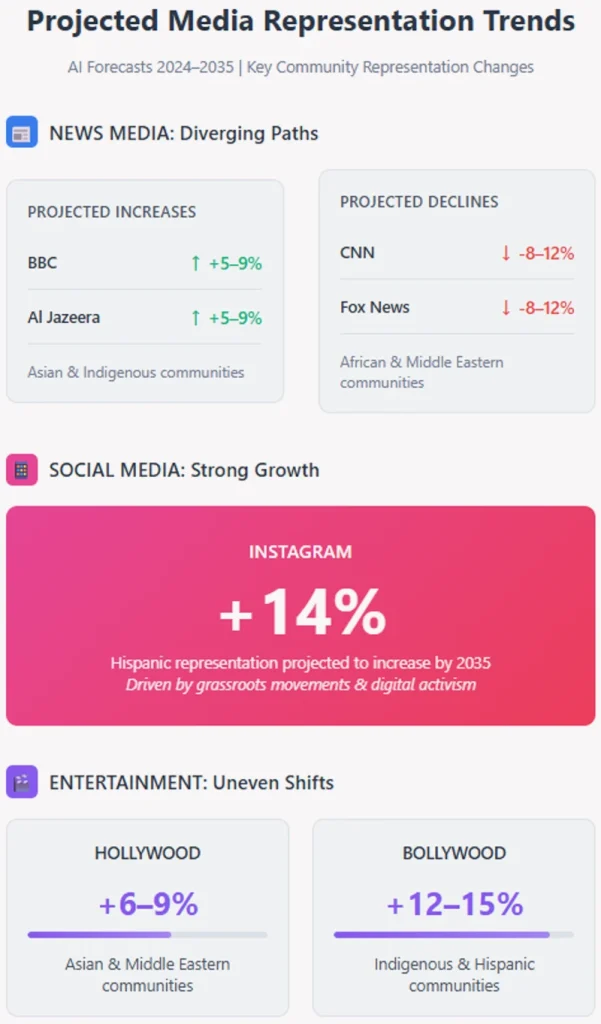
Some of the most striking projections include:
- News media is diverging, not converging
BBC and Al Jazeera show projected increases (5–9%) in Asian and Indigenous representation, while CNN and Fox News forecast declines (8–12%) for African and Middle Eastern communities. - Social media continues to amplify grassroots visibility
Hispanic representation on Instagram is projected to increase by 14% by 2035—reflecting the growing influence of digital activism and creator-driven narratives. - Entertainment industries are shifting unevenly
Hollywood shows modest growth (6–9%) for Asian and Middle Eastern communities, while Bollywood projects stronger gains (12–15%) for Indigenous and Hispanic representation.
The takeaway? Representation trends vary across media types and communities, with some showing steady improvement while others remain stagnant or face declines.
Going Beyond Mentions: Measuring How Communities Are Represented
One of the most important contributions of the study isn’t just what it predicts, but how it measures representation.
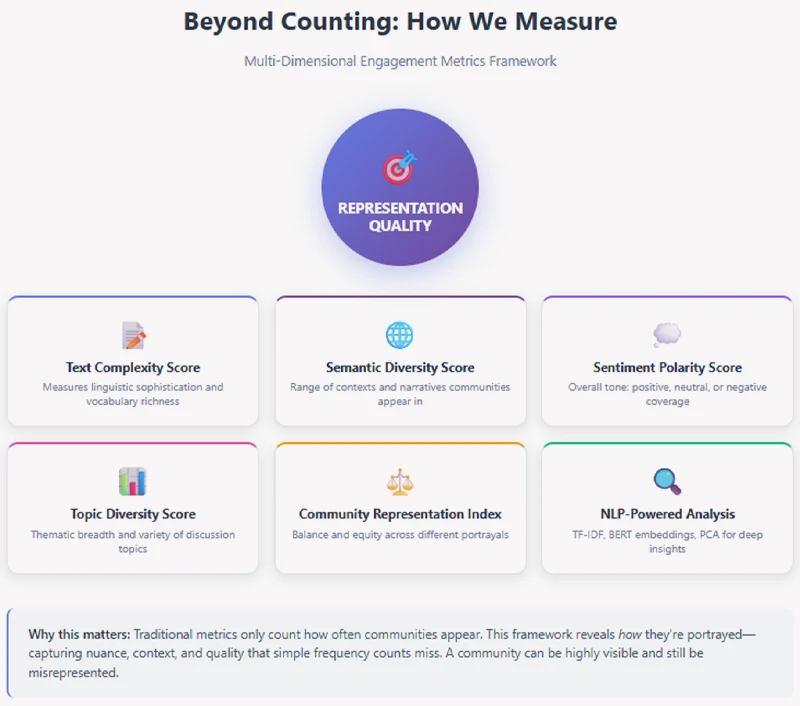
Instead of simply counting appearances, the researchers developed a multi-dimensional engagement metric framework using advanced NLP (Natural Language Processing) techniques. These include TF-IDF (a method that identifies which words are most meaningful in a text) and BERT embeddings (an AI tool that understands context and meaning in language). This framework captures:
- Language complexity – how communities are discussed
- Contextual diversity – the range of narratives they appear in
- Sentiment polarity – positive, neutral, or negative tone
- Representation balance – how equitably coverage is distributed
This approach reveals something traditional metrics miss: a community can be visible and still be misrepresented.
From Research to Real-World Use
Importantly, this work doesn’t stop at academic analysis.
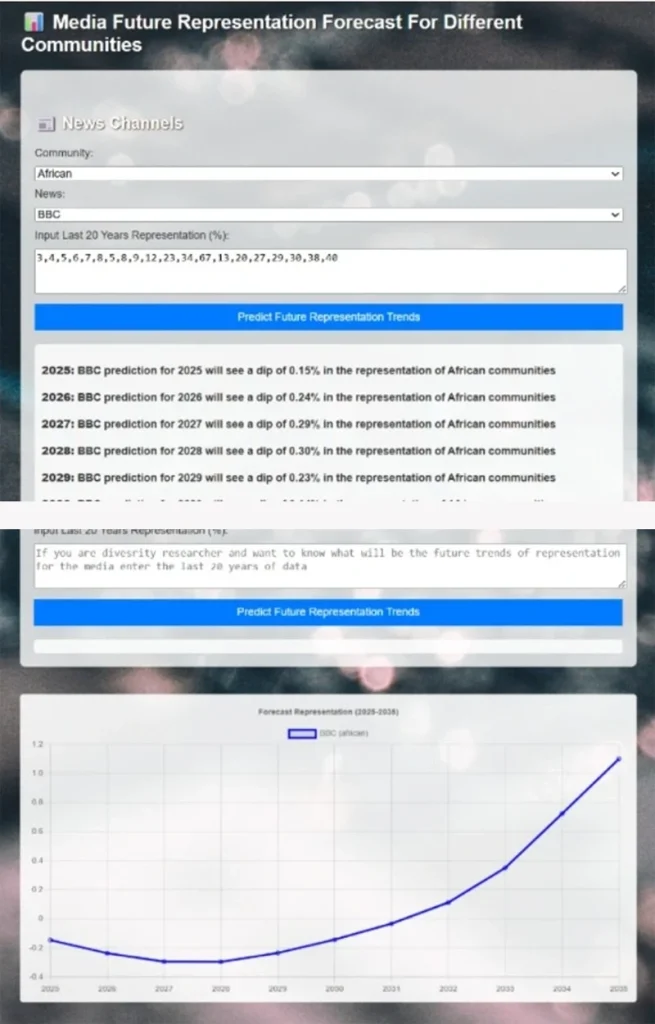
We’ve launched an interactive web application that allows users to explore forecasts by community, platform, and media type. This opens the door for practical use across sectors:
- Media organisations can identify emerging representation gaps
- Advocacy groups can prioritise evidence-backed interventions
- Policymakers can ground decisions in long-term trend data
Instead of reacting to representation failures, stakeholders can now anticipate them.
Why This Research Matters Right Now
Media representation isn’t just theoretical. Studies consistently show that communities with higher-quality media visibility experience:
- Stronger senses of belonging
- Greater trust in institutions
- Higher levels of civic participation
On the flip side, persistent negative or absent representation reinforces stereotypes, shapes public policy debates, and deepens inequality.
At a time when algorithms increasingly decide what stories surface, and which don’t—understanding these patterns isn’t optional. It’s essential infrastructure.
Looking Ahead
The study points toward future possibilities: real-time monitoring systems, cross-platform influence analysis, and early-warning tools for representation decline.
As media ecosystems grow more fragmented, the ability to see representation clearly and act on that insight, may determine whether diversity efforts succeed or stall.